What is a Swiss tournament?
In a Swiss tournament you play people on a similar score each round, so leaders meet leaders and everyone plays every round. You get a reliable ranking in far fewer rounds than a full round robin.
How many matches? You choose the number of rounds. The default is log₂ of the player count, rounded up, with a minimum of 2 (3 rounds for 8 players, 5 for 32).
How to run a swiss in the app
- Select players and set the number of rounds. The default is shown as "Default: N rounds for M players".
- Each round pairs players by the current standings with someone they haven't played yet.
- If everyone has already met, the app allows a rematch rather than leave someone out.
- With an odd number of players, the player who has had the fewest byes gets the next one. A bye counts as a win.
- In doubles, each group of four is re-teamed from the standings, so partners and opponents change.
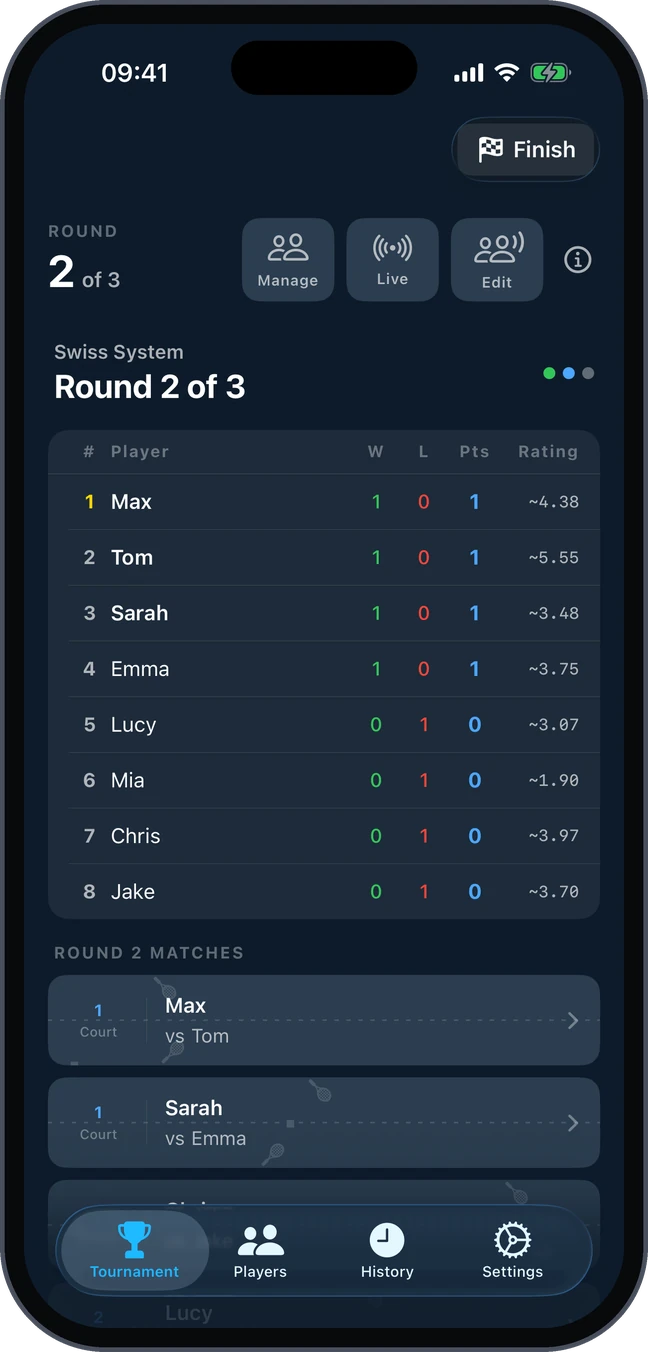
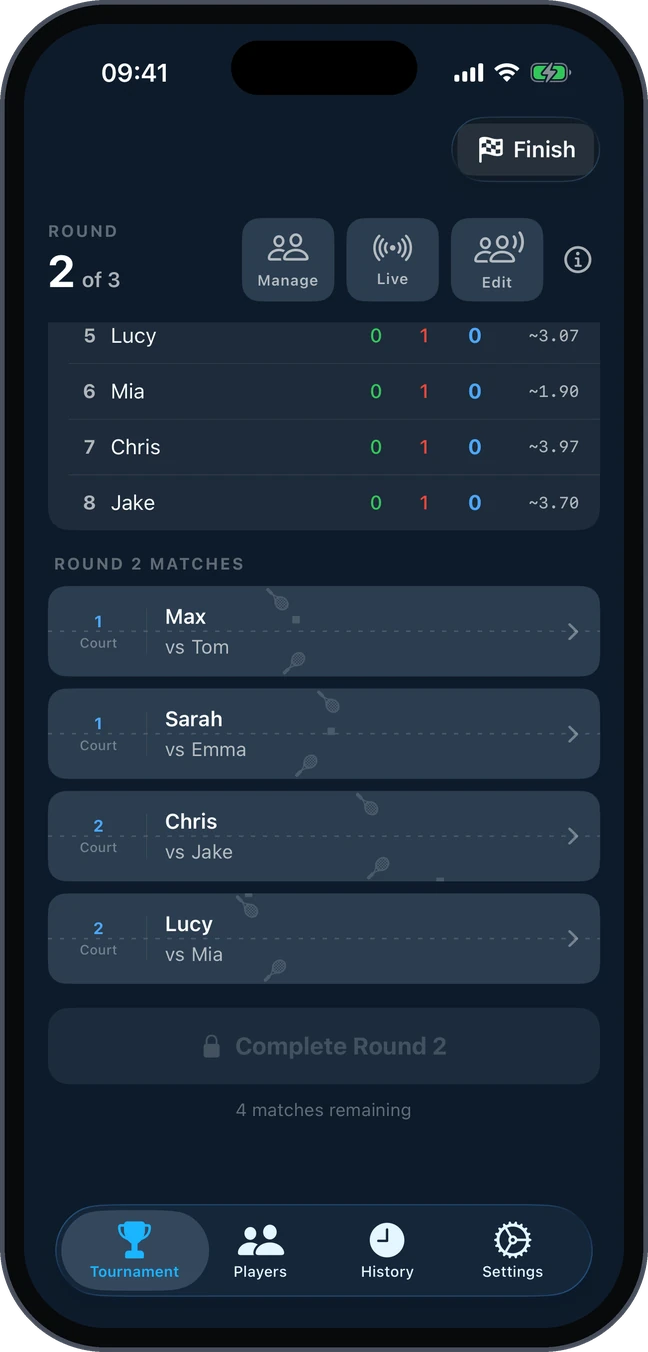
How the table is ranked
- Points (win 1, draw ½)
- Point difference, if you're tracking scores
- Players still level share a rank
Pros and cons
Pros
- Everyone plays every round
- A strong ranking in a few rounds
- Works for large groups
Watch out for
- Each round depends on the last one, so the schedule can't be printed in advance
Best for
- Bigger groups where a round robin would take too long
- Events where everyone should play every round
- Chess-style events (track scores and enter level results as draws)
Organiser tips
- Courts are ordered by player strength, so the top matches are on Court 1.
Popular sports for swiss
Swiss FAQ
How many rounds should a Swiss tournament have?
The default is log₂ of the number of players, rounded up (minimum 2): 3 rounds for 8 players, 4 for 16, 5 for 32. You can change it at setup.
Are draws allowed?
Yes. When you're tracking scores and they're level, the match is a draw worth ½ a point.
Does it use Buchholz tie-breaks?
No. Level players share a rank. Points and point difference decide places.